

White, Hairy Spots on Your Shingles? Here Is What It Actually Means
If you have ever looked up at a roof and noticed a patch that looks white and almost hairy, like this one we spotted on a recent job in Toccoa, that is not mold, moss, or debris. That is exposed fiberglass matting, and it is one of the clearest signs a section of roof has reached the end of its service life.
What Exposed Fiberglass Matting Actually Is
Asphalt shingles are built in layers. On top is a coating of small stone granules, and those granules do a lot of the real work. They shield the asphalt underneath from UV rays, add fire resistance, and give the shingle its color and texture. Underneath that granule layer sits a fiberglass mat, the structural base that holds the shingle together.
When a shingle loses enough of its granules, usually from age, sun exposure, hail impact, or foot traffic, that fiberglass mat becomes visible. It shows up as a lighter, almost white patch with a rough, fibrous texture, which is exactly why it can look hairy from a distance.
Why This Is a Bigger Problem Than It Looks
Losing a few granules here and there is normal wear over time. But once the fiberglass mat itself is exposed, the shingle has lost its main layer of protection. That section of roof is now significantly more vulnerable to water intrusion, since the mat is not designed to be a standalone waterproof layer. It is also more exposed to accelerated UV damage, cracking, and further granule loss spreading to nearby shingles.
This is not a cosmetic issue. It is a sign that the shingle in that spot has failed, and depending on how widespread it is, it can point to a roof nearing the end of its overall lifespan rather than just needing a small repair.
What Causes It
A few common causes seen across Northeast Georgia roofs:
Age. Most asphalt shingles are built to last 20 to 30 years, and granule loss accelerates significantly in the final years of that lifespan.
Hail and storm damage. Impact from hail can knock granules loose all at once rather than gradually over time, which is why a single storm can sometimes expose fiberglass matting in isolated spots.
Heat exposure. South facing and heavily sun exposed sections of a roof tend to show this wear first.
Foot traffic. Walking on a roof, whether during a repair, an installation, or routine maintenance, can dislodge granules if not done carefully.
What To Do If You See This On Your Roof
If a patch like this shows up, it is worth having it looked at before it turns into an active leak. A professional inspection can tell you whether it is an isolated spot that can be addressed with a targeted repair, or a sign that the whole roof is due for replacement.
Big League Roofing offers free roof inspections throughout Northeast Georgia, including Commerce, Athens, Gainesville, and Toccoa. If a roof has spots that look worn, white, or fuzzy, give us a call before it becomes a bigger problem.
📞 (706) 244-2421
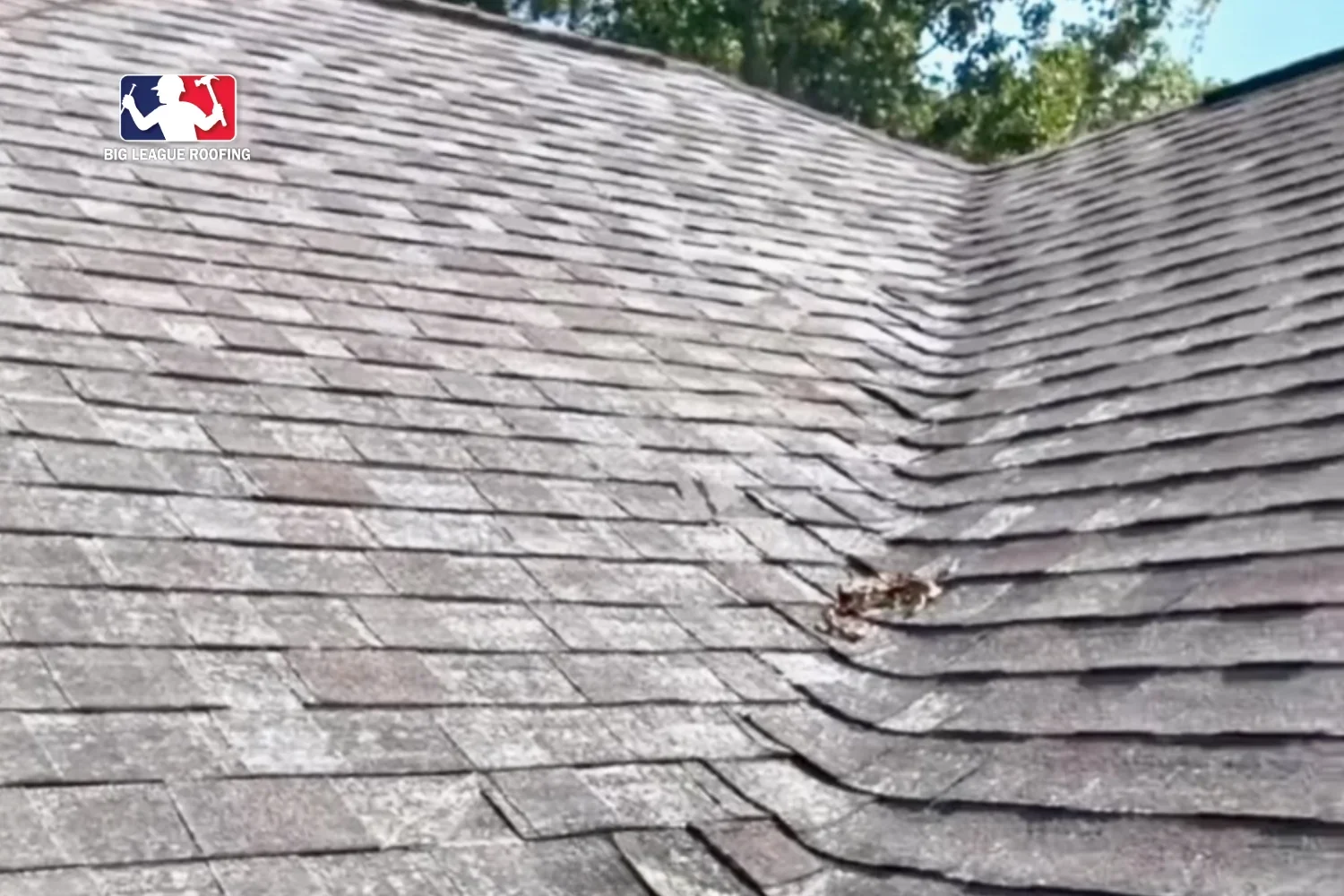
Exposed fiberglass matting on worn asphalt shingle roof in Toccoa, Georgia
